What Is The Most Crowded Month In Glacier National Park?
July is the most crowded month in Glacier National Park, and the monthly visitation counts show it. Here is what the numbers mean for a 9am Logan Pass arrival.
What Is The Most Crowded Month In Glacier National Park?
July is the most crowded month in Glacier National Park, every single year, and the counts are not close. In 2025 the park recorded 765,061 recreation visits in July against 718,766 in August. In July 2026 the figure jumped to 896,386, a 17.17 percent increase over the same month in 2025 and the fourth-busiest July on record. July and August alone were 47.3 percent of the year's visits.
The numbers come from the National Park Service's own visitor use statistics, the same data set that produced the 3,136,557 recreation visits recorded across all of 2025. Monthly counts are worth more than impressions here, because they show the shape of the year rather than a single anecdote about a full parking lot. July is the peak of that shape, and it is the month when the park's infrastructure, the road, the shuttles, the trailheads, is under the most strain.
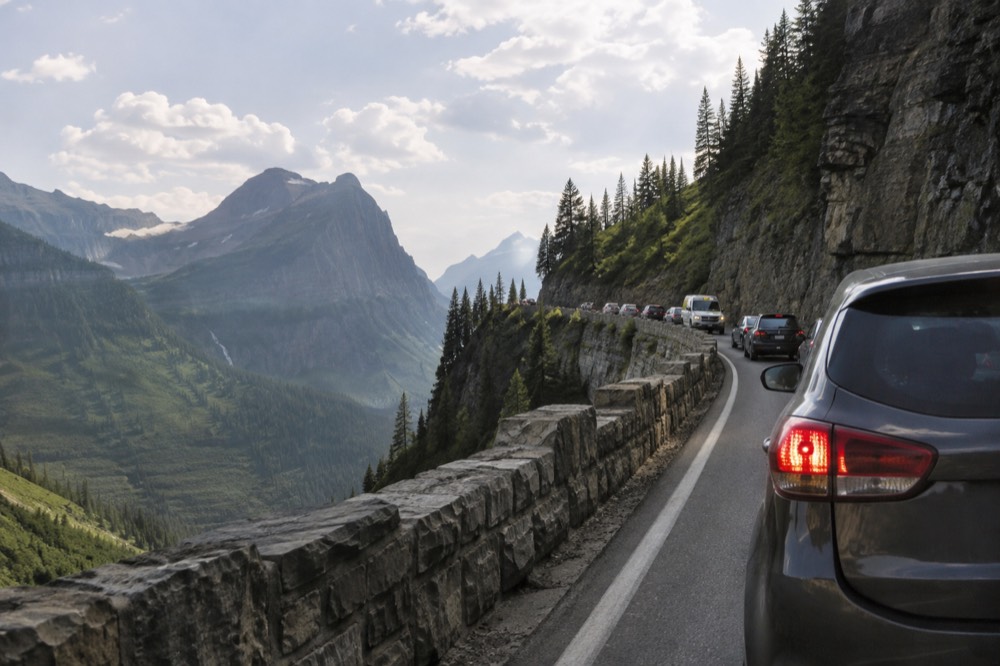
July's dominance has a simple mechanical cause. It is the first full month in which Going-to-the-Sun Road is reliably open end to end, school is out across most of the country, and the weather at higher elevations is at its most forgiving. In 2026 the road opened fully on June 22, and by July the alpine section was running at full capacity. August runs a close second, and June a distant third, but nothing else approaches the July peak.
If you want to see what the crowd pressure actually feels like, the answer is a 9am arrival at Logan Pass, which is the subject of the next section.
What Do The Crowd Numbers Mean For A 9Am Logan Pass Arrival?
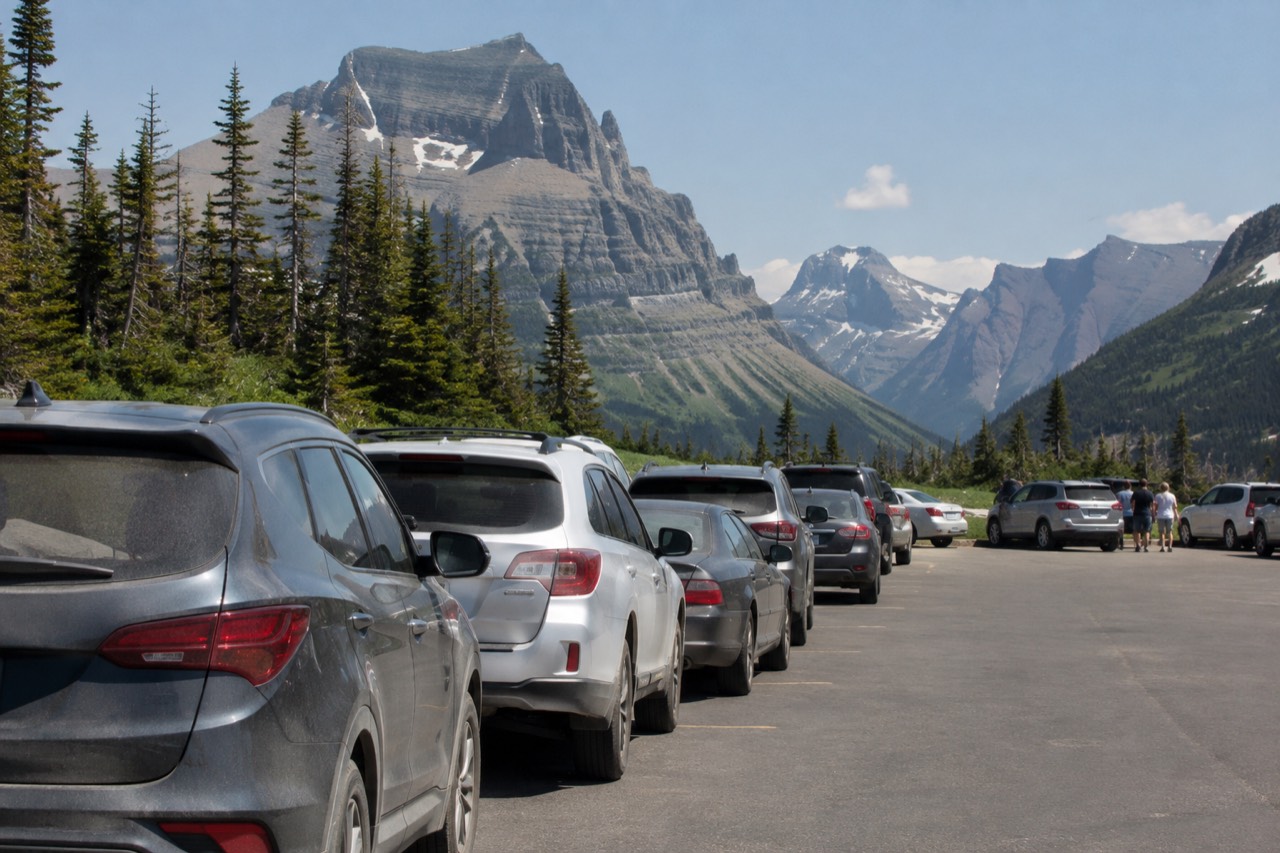
A 9am arrival at Logan Pass in July means the parking lot is already full, because the 2026 three-hour parking pilot filled the lot well before mid-morning on peak days. The lot at 6,646 feet is the road's highest point and its most contested piece of pavement. Visitors who arrived by 8am generally found a space; at 9am they generally found a diversion sign and a return trip later in the day.
In 2026 the park ran two experiments aimed directly at this problem. The first was a ticketed-only shuttle to Logan Pass, operating July 1 to September 7, with tickets sold on Recreation.gov for a $1 processing fee per person. The second was a three-hour parking limit at the Logan Pass lot over the same window, enforced 24 hours a day: you park, collect a free timestamped permit from a kiosk, and put it on the dashboard. The park's own reporting on the record July suggested the time limits helped turnover, but they did not make a 9am arrival easy.
The practical reading of the numbers is this. July 2026's 896,386 visits, spread over 31 days, average to a daily volume that dwarfs what the pass can absorb. Logan Pass has a few hundred parking spaces. Even allowing for the fact that most visitors never reach the pass, the arithmetic only closes one way: the lot fills early, and the people who fill it are the people who arrived before the tour buses and the shuttle crowds.
The alternatives at 9am are the shuttle (if you booked a ticket the night before at the 7pm MDT release), a guided tour with an authorized operator, or an early start you did not want. The park itself says that visitors with oversized vehicles, which are banned from the alpine section anyway if longer than 21 feet or wider than 8 feet including mirrors, can either secure a shuttle ticket or reserve a guided tour with an authorized commercial operator. That is the park naming the two real options.
For travelers who want the road's full 50 miles without a 6am alarm, an audio tour driven in your own car is the third path, and it is the one this site can actually book.
The Going-to-the-Sun Road audio tour costs from $9.99 per group of up to 15 people, runs 10 to 11 hours of narration across the full drive, and holds a 4 rating across 27 reviews. It does not reserve you a parking space, nothing does, but it does let you time your own day around the crowd curve rather than a tour operator's schedule.
How Do The Monthly Visitation Numbers Break Down?
The 2025 monthly counts run from 15,202 visits in February to 765,061 in July, a fifty-fold difference between the quietest and busiest months. June through September accounted for 2,612,883 visits, 83.3 percent of the entire year. July and August alone were 1,483,827 visits, 47.3 percent. The deep winter months are a rounding error by comparison.
Here are the actual 2025 counts from the National Park Service visitor use statistics:
| Month | 2025 recreation visits |
|---|---|
| January | 17,984 |
| February | 15,202 |
| March | 25,909 |
| April | 48,576 |
| May | 238,766 |
| June | 576,577 |
| July | 765,061 |
| August | 718,766 |
| September | 552,479 |
| October | 127,537 |
| November | 27,967 |
| December | 21,733 |
The pattern repeats every year with small variations. July is the peak, August is close behind, and June and September form the shoulders. May and October are transition months where the road is partly closed and the counts halve. The deep winter is a different park entirely, one where the 15,202 visits of February 2025 are spread across snowbound valleys and the alpine section of the road is closed to cars.
The 2026 numbers so far confirm the same shape at a higher level. Year-to-date visitation through July 2026 reached 1,823,478, with the record July pulling the total upward. The park's all-time record year remains 2017, with 3,305,512 recreation visits, and 2026 was tracking toward numbers in that territory through the summer.
Which Months Give You The Park Without The Crowds?
September is the strongest crowd-avoidance month that still has full road access, with 552,479 visits in 2025 against July's 765,061, and June is second best before the absolute peak. Late September brings fall color, active wildlife and the year's most stable weather window after the summer heat. The trade is a real one: early snow can close the alpine section at any point after mid-September.
September's case is strong on the numbers alone: roughly 28 percent fewer visits than July. But the qualitative case matters more. West Glacier's September normals, from the NOAA 1991-2020 record, average a high of 68.0 degrees and 1.96 inches of precipitation, cooler and drier than June. The park's own weather guidance notes that snow can fall at lower elevations as early as mid-September, and in 2026 that is exactly what happened, with a light snowfall closing the alpine section between Avalanche Creek and Jackson Glacier Overlook on September 14 and dusting the Highline Trail and Hidden Lake Trail.
June is the other shoulder play. The 576,577 visits of June 2025 sit well below July, and the first half of the month is quieter still, but the road's full opening date swings the experience: in 2026 it was June 22, and in 2011 and 2020 the pass did not open until July 13. A June trip is a bet on the plow schedule.
May and October are for travelers who accept a partly closed road in exchange for near-solitude. The winter months belong to skiers and snowshoers, and the park's guided snowshoe treks, which run from $230 per person with hotel pickup, are the bookable way into that version of Glacier. For more on timing the whole decision, the best time to visit guide works through the trade-offs month by month.
Can A Guided Or Self-Guided Tour Dodge The July Crowds?
Yes, partly. A guided tour does not make Logan Pass empty, but it removes the parking lottery, because tour vehicles do not compete for the public lot, and 2026's congestion diversions let service-reservation holders through when others were turned away. A self-guided audio tour in your own car trades that protection for total control of your start time, which is the single biggest lever on crowds.
The 2026 policy detail worth knowing is that when the park closed the alpine section temporarily for congestion, visitors holding service reservations, boat tours, lodging, horseback rides, guided hikes, were still let through, though possibly delayed. That is a real, documented advantage for booked tours in the busiest weeks. The reservation system itself was gone in 2026: no vehicle reservations were required anywhere in the park, at any entrance or corridor, for the whole season, a change from the prior five years.
On the guided side, the roster's bookable options include a west-side driving tour at 4.8 across 37 reviews from $250 per person with lunch and hotel pickup, which covers Apgar Village and Lake McDonald without touching the alpine section at all. The guided day tours guide compares the formats.
On the self-guided side, the audio tours are the crowd-flexible option. The Going-to-the-Sun Road audio tour and the North Fork audio tour, both from $9.99 per group of up to 15, let you leave West Glacier at dawn if you choose. The North Fork tour is a genuine escape valve: it covers the Polebridge Mercantile, Bowman Lake and Kintla Lake, a corner of the park that the shuttle system never reaches and most July visitors never see. It is a new listing with no reviews yet, so there is no rating to report.
The honest framing is that no tour empties the park. What a tour changes is which lottery you are in: the parking lottery, the shuttle-ticket lottery, or no lottery at all because someone else is driving and holds the access rights.
What Time Of Day Beats What Month?
Within July, your start time matters more than almost any other decision: a 6am Logan Pass arrival in July is calmer than a 10am arrival in September. The park's own shuttle schedule encodes this, with first departures at 6:00 am from Apgar Visitor Center, St. Mary Visitor Center and Rising Sun. The last westbound departure from Logan Pass is 7:30 pm, and there is no other public transport back if you miss it.
The crowd curve inside a day is steep. The three-hour parking pilot at Logan Pass existed precisely because cars were circling the lot for hours in the middle of the day. Arrive before 7am and you park; arrive at 9am in peak July and you are reading a diversion sign. The same curve applies to Trail of the Cedars, Avalanche Lake, and the Apgar Village area, all of which sit on the west-side corridor that carries the heaviest traffic.
The bicycle restriction on the road encodes the same logic: from June 13 to September 28, bicycles are prohibited eastbound from Apgar to Logan Pass between 12 pm and 6 pm, and westbound from 3 pm to 6 pm, because the midday road is too busy to share. The e-bike and cycling tours on the roster, including a Camas Road e-bike tour from $229 per person, deliberately use the quieter Camas Road corridor rather than the alpine section.
For travelers who cannot face a 5am alarm, the evening is the second-best window. On September 14, 2026, sunset at Lake McDonald was 7:50 pm, and midsummer evenings stretch even later. The glass kayak sunset tour on Whitefish Lake, 4.8 across 55 reviews from $140 per person, and the LED clear kayak rentals on Flathead Lake are built around exactly this: the hours when the day crowds have gone to dinner.
How Do You Read The 2026 Changes Against The Crowd Data?
The 2026 season removed vehicle reservations entirely, ran a $1 ticketed shuttle and a three-hour Logan Pass parking limit from July 1 to September 7, and still recorded its fourth-busiest July ever at 896,386 visits. The lesson in the data is that entry friction was never the main variable: the road's capacity and the pass's parking lot set the ceiling, and July hits it regardless of policy.
The park's historic reservation volumes show how much demand the old system managed: 135,086 reservations released in 2021, 180,832 in 2022, and 257,309 in 2023 across four corridors. In 2026, none were needed. The park's official fees and reservations pages carry the current policy, and the visitor use statistics carry the counts behind it.
For trip planning, the 2026 changes cut both ways. No reservations means no 6am ticket scramble before your trip, a real simplification. But it also means the crowd pressure lands directly on the parking lots and the shuttle instead, which is exactly where the July numbers say it landed. The three-hour parking limit was the park's answer, and it changed the pass from an all-day base camp into a rotating one.
The other 2026 wrinkle is the departure-point change: Sun Tours and Red Bus tours that previously departed from the Apgar Visitor Center moved to the newly designated Quarter Circle Parking Lot. Anyone arriving at Apgar expecting to board a tour there in 2026 found a walk instead. Small details like this one move real people in July, which is why this site's Glacier National Park Tour Packages comparisons track them.
Common Questions About Crowded Months In Glacier National Park
What Is The Most Crowded Month In Glacier National Park?
July, by a wide margin. In 2025 the park recorded 765,061 recreation visits in July against 718,766 in August, and July 2026 reached 896,386, the fourth-busiest July on record. July and August together accounted for 1,483,827 visits, 47.3 percent of the year.
Is August As Crowded As July At Glacier?
August is close, at 718,766 visits in 2025 against July's 765,061, but July stays ahead every year. August does have one advantage: it is slightly drier at West Glacier, averaging 1.17 inches of precipitation against July's 1.39.
What Is The Least Crowded Month With The Road Still Open?
September. It recorded 552,479 visits in 2025, about 28 percent fewer than July, and the alpine road typically stays open until around the third Monday in October. The risk is early snow, which closed the alpine section temporarily on September 14, 2026.
Do I Need A Vehicle Reservation To Visit In July?
No. Vehicle reservations were not required anywhere in the park in 2026, at any entrance or corridor. In their place the park ran a ticketed Logan Pass shuttle and a three-hour parking limit at the pass from July 1 to September 7.
What Time Does Logan Pass Parking Fill In July?
Early. The 2026 three-hour parking pilot filled the lot well before mid-morning on peak days, and a 9am arrival generally meant a full lot. Arriving before 7am is the reliable window; the first shuttles left Apgar at 6:00 am for the same reason.
Can A Tour Help Me Avoid The Crowds?
Partly. Tour vehicles do not compete for the public lot, and in 2026 the park let visitors with service reservations through congestion diversions that turned others away. A self-guided audio tour in your own car instead gives you control of your start time, which is the biggest crowd lever of all.